Information about Moa


This task is about finding the features of a science text.

A science report is a type of text that gives information about things and groups of things, such as birds. The following science report gives information about moa. 

Read the science report about moa and think about the different text features used. 


Moa

Moa lived very successfully in New Zealand for many hundreds of thousands of years, only becoming extinct some time after the arrival of people. Evidence that moa existed is provided by fossils. It is known from the fossilised bones that have been found that moa were large birds, with the largest reaching 1.8 meters at the highest point on their backs, and weighing up to 240 kilograms. Although they had a small head, they had a long neck, large body, and large, powerful legs. The breast bones of moa are similar to that of several living flightless birds. This, along with their size, means it is likely that moa could not fly. It is also likely that moa behaved in similar ways to some living flightless birds. Evidence that they, like kākāpō, ate twigs, seeds, berries, and leaves, and browsed on shrubs (rather than ate grass as some flightless birds do) has been provided by preserved stomach contents that have been found.
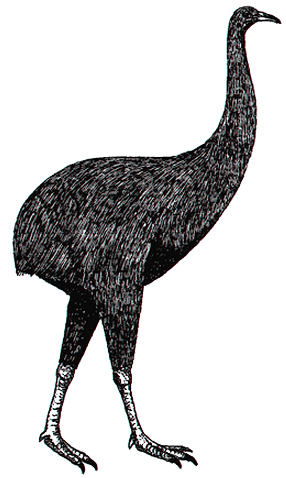
 

sketch of a moa

Question 1Change answer

a) Find the opening statement in "Moa".

An opening statement is 1-3 sentences, included at the beginning of the text, that introduce what is being written about. This is followed by specific statements. In the examples below, the opening statement is written in italics.

  • Cicadas are insects. They live all over the world except very cold areas. New Zealand has 38 species of cicada …
  • Potatoes are native to Peru and were taken to Europe about 600 years ago. They are now the world's most widely grown vegetable. The Agria variety is floury so is best suited to roasting and chips…

Question 1Change answer

b) Find two pieces of information that are given to build your understanding.
Sometimes, authors give us information to gradually build up understanding of a topic (step-by-step). Consider the example below
  •  Kiwi mostly eat grubs, worms, and seeds. They don't need to see, feel, or hear food that lives underground. Instead, they smell it with the nostrils at the end of their long beak.
In this example, the author tells us 1) what kiwi eat, 2) what senses kiwi don't use to find food, and 3) how kiwi find food. Together, these three pieces of information buil our understanding of the eating habits of kiwi.
Starting in line two of "Moa", it says, "evidence that moa existed is provided by fossils." 
Find two pieces of information that add to this statement.
 
1.
2.

Question 1Change answer

c) Find two examples of language that is used to classify moa (classifying language).
Classifying language is language that is used to explain the group or groups that something, like moa, are a part of. 
In the examples below, the groups are meteors, spides, birds, and things that are native to New Zealand. Classifying language helps us to make connections between our knowledge and new concepts.
  • A fireball is a very bright meteor.
  • Katipō belong to the same group of spiders as the Australian redback.
  • Kiwi are flightless birds.
  • Kākāpō are native to New Zealand.
1.
2.

Question 1Change answer

d) Find four examples of technical language that is used to give information about moa.
Technical language is used to talk or write about particular topics. It is not used much in our everyday lives. The list below gives technical language that could be used to talk or write about dolphins.
  • Hector's dolphin; Māui dolphin; dorsal fin; flippers; marine mammal; carnivore; Department of Conservation
1.
2.
3.
4.

Question 1Change answer

e) Find four examples of language that describe what moa looked like.
Descriptive language can be used to describe facts in reports and describe things, places, and people in narratives. The examples below use descriptive language to describe facts about the appearance of different things.
  • Most species of whale have a dorsal fin on their back.
  • The adult black stilt is greenish black.
  • Fixed wing aircraft have a pair of long, narrow, flat, nearly horizontal wings.
  • Sharks have several rows of teeth which grow, and are replaced, throughout their lives.
1.
2.
3.
4.

Question 1Change answer

f) Find two examples of language that describe what moa did or did not do.
Descriptive language can be used in a report to describe what a group of things, like birds, do. 
For example:
  • Female whales give birth to a single calf.
  • Black stilts feed on aquatic invertebrates, molluscs, and fish.
1.
2.

Question 1Change answer

g) Find the group that this report talks about.
In reports, language is often used to describe groups of things. Usually 1 or 2 words are used to give the name of the group.
  • For example, "ants" describes a group, but "that ant" describes an individual. 

Question 1Change answer

h) Find examples of language that is used to compare groups.
Language that is used to compare groups describes what is the same or similar, and different, about things in those groups. 
For example:
  • Maui's and hector's dolphins both have a rounded dorsal fin and a blunt beak. 
Find one example of language telling how groups of things are similar:
Find one example of language telling how groups of things are different:

Question 1Change answer

i) Find one example of objective language.
Objective language is language that is fair and impartial. It is useful for explaining facts and information without judgemental or emotional statements. The opposite of objective is subjective. Subjective language gives us information about emotions and judgement. 
For example: 
  • Bloodworms kill their prey by injecting poison through their fangs (objective). 
  • Blood worms are ugly, brutal killers (subjective). 
Published on Assessment Resource Banks (https://arbs.nzcer.org.nz)