
Kia ora. Nau mai, haere mai.
These guidelines were developed from the Assessment Resource Banks Māori Steering Group hui recommendations.
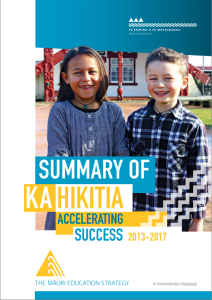
“Ensuring Māori students enjoy and achieve education success as Māori is a joint responsibility of the Crown (represented by the Ministry of Education and other education sector agencies/departments) and iwi, hapū and whānau.” Ka Hikitia (2013, p. 13)
Five guiding principles that steer Ka Hikitia – Accelerating Success:
- The Treaty of Waitangi – ensuring Māori students enjoy and achieve education success as Māori is a shared experience.
- Māori potential approach – high expectations for Māori students to achieve
- Ako – a reciprocal two-way teaching and learning process
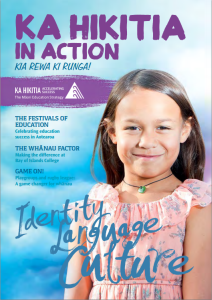
- Identity, language and culture count – Māori students benefit from seeing their experiences and knowledge reflected in teaching and learning
- Productive partnerships with key stakeholders – ongoing exchange of knowledge and information and the involvement of parents and whanau.
Adrienne Alton-Lee (2014, in draft) has identified “7 critical success factors” which enact the principles of Ka Hikitia
- Indigenous educational expertise
- Whakawhanaungatanga driving the ‘how’ of improvement
- Effective teaching: culturally responsive pedagogy
- Effective professional development: building school-based expertise
- Transformative educational leadership: reforming schools
- Educationally powerful connections
- R&D driving accelerated improvement to scale
The following three principles fit within the Treaty of Waitangi from the 5 guiding principles of Ka Hikitia.
Principle 1: Participation
The ARBs and associated development process should embody the Treaty of Waitangi principle of participation.
- Help teachers be assertive, confident and accurate about supporting/building diverse understandings of Māori world views.
- Provide prompts to raise teacher and student awareness of Māori world views.
- Provide support for teachers to acknowledge the culture and background and lens that students bring to a task.
- Provide appropriate prompts for teachers to use with Māori students to encourage their engagement.
- Ensure that it is clear to teachers that a resource on its own cannot ensure cultural responsiveness. Ultimately how the teacher uses the resource and their reflection on its effectiveness is the most important factor.
- Present culturally relevant support information in ways that does not cause information overload for teachers:
- Limit number of links to other resources.
- Give access to very specific relevant information for the task
- Provide a space in Support Material for more general background information that is relevant across resources.
Principle 2: Partnership
Model an effective Treaty of Waitangi partnership.
- Plan for dual Māori/English focus at the start of each resource’s development.
- In relevant places in the resources, make explicit the rationale for inclusion of Māori contexts and how this supports the learning of tauira Māori (Māori learners)
- Māori world views should be incorporated by Māori throughout ARB content, including the student tasks section, the teachers’ pages and the support material.
- Promote the value of formative assessment in promoting learning from the starting point of students’ experiences and understandings, including their cultural viewpoints.
Principle 3: Protection
Effective assessment resources help protect and build understanding of Māori world views.
- Design items that allow Māori students to bring their experiences and world views to the assessment task.
- Ensure that Māori students can see themselves in the assessment tasks.
- Provide for a range of assessment strategies (e.g., individual and group, peer assessment. oral and written).
- Develop resources that are viewed through a Māori lens alongside or separate from other world views (for example looking at a conservation issue through a Māori lens e.g. kaitiakitanga: the practice of rāhui to stop people taking kai from a depleted source of shellfish as well as or instead of a Department of Conservation lens).
- Use relevant Māori language in ARB resources.
- Use key Māori words both as keywords for searching for resources and definitions where appropriate for both students and teachers.
- Use Māori imagery/visual representations to help Māori students to connect with their culture.
- Encourage teachers to use resources in ways that support Māori students’/tauira knowledge.
- Support the relationship loop. Encourage interaction between students and teachers and between students.
Links
 |
|
 |
Te Kotahitanga - Te Kotahitanga is a project that seeks to improve the educational achievement of Māori students in mainstream schools. Through interviews with Māori students, their teachers and whānau, the authors learnt about the characteristics of teachers that made a difference. They have drawn these together into the Effective Teaching Profile.