
The ARB resources cover three curriculum areas, a range of topics and levels, and can be used in many ways to support teaching and learning. When planning for learning, there are three broad fields that you might start from: a topic or context, the curriculum, or your students' strengths and needs.
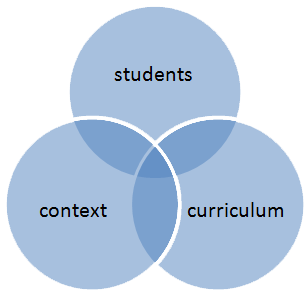
Adapted from Teaching Writing across the Curriculum in Years 4-6,
New Zealand Ministry of Education, 2012
Whatever your starting point, planning should include activities that provide evidence for making decisions about students' learning. The ARBs is one resource that provides activities designed to support teachers and students to do this.
Starting from the students
In this article, the starting point is students' strengths and needs in mathematics. There are many reasons for planning a unit of work beginning from the strengths and needs of students. It may be that you have just undertaken a class assessment such as PAT Mathematics or NumPA. From analysis of the results, it may be clear what the next maths focus should be.
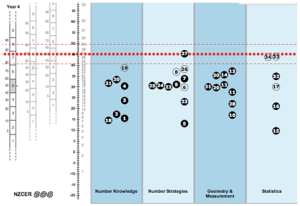
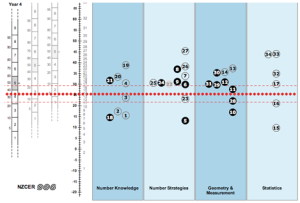
This example is based on PAT results for a Year 4 class. As a whole, they were achieving in a similar way to the national reference picture. However, many students had a maths profile that was not particularly 'even'. It appeared that there were particular maths concepts that needed deeper understanding than other concepts as the students had not been able to answer some questions accurately. In the area of statistics, a group of students at stanine 7 made a few unexpected mistakes and another group at stanine 4 appeared not to understand how to interpret any of the graphs and did not attempt any of the questions. The two PAT individual reports shown are typical of these groups.
Knowing about the students
- What patterns of strengths and needs do the class PAT results show? What do students already know about statistics enquiry? What did I expect them to know that the results suggest they don’t?
- What is the expectation at Level 2 of the NZ curriculum and for the National Standards in mathematics for the end of Year 4? What do students need to know
- For both individuals and groups, what statistics enquiry concepts do they need to practise, and what will I need to teach?
- Which students need more explicit teaching to accelerate their statistics learning?
- Where will I find tasks that will provide students with a wide range of opportunities to explore statistical concepts?
The ARB resources are designed for drilling down to find out more about what a student is doing and thinking. This provides useful data for making decisions about what needs to be done next.
When searching for ARBs, check that the task focuses on the aspect you are interested in exploring in depth and is suitable for your students. The task description is useful for identifying the specific focus of the resource. The teacher guide provides detail on what to notice while students are completing the task, and also provides examples of student responses and suggested next steps.
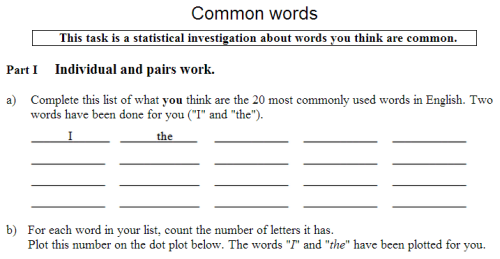
The ARB task Common Words (ST8112) gives the teacher rich information about students’ knowledge of data and graphing in a familiar context. It is a level 2 task.
Knowing about the curriculum
- What do I understand about statistical enquiry?
- What statistical enquiry idea could be explored?
- What does the curriculum say students should understand about statistical enquiry?
- What do I understand about mathematical learning communities – the way the students will discuss their statistical enquiry, reasoning and argumentation?
For example
|
NZ Curriculum Mathematics, Level 2
Statistical literacy |
Mathematics National Standards
|
The ARB website has a range of general and curriculum-related teacher resources.
You can search for these in the information blocks under the search field on the ARB homepage:
- ‘National Standards’ (In Knowing about assessment).
-
Clicking on the National standards filter will display National Standards for Reading, Writing and Mathematics.
- Click on the tile to access either one of these three frameworks to support teacher with their OTJs.
- ‘Research and articles’.
- All research and articles across all banks are displayed as tiles.
- Clicking on the maths filter to see the maths related articles specifically designed to help build maths pedagogical content knowledge.
- With the focus on statistical enquiry the teacher would find the following ARB material useful.
1. Support materials
In the ‘Support materials and research’:
-
Tables and graphs (2008)
In the ‘Maths support materials’ there are documents and PowerPoints in the ‘Short articles’ section about statistics: - Statistical Enquiry Cycle (2011)
-
Types of data: Statistics (2009)
In Research and articles and filtered by maths there are more generic maths documents. One useful one for this group of Year 4 students and the focus on statistical enquiry would be: Mathematical classroom discourse (2006) -
Further research on classroom talk can be found on the MoE site http://www.educationcounts.govt.nz/topics/BES/bes-exemplars
The BES Exemplar 1: Developing communities of mathematical inquiry describes how two teachers developed their students’ communication and participatory skills through active participation in the classroom mathematical discourse community.
2. The National Standards
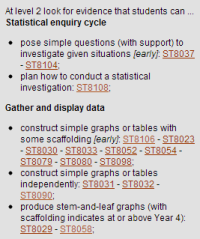 |
The Mathematics National Standards provides lists of ARB tasks that could be used to support both student learning and assessment in statistics (OTJ). For this particular class and the students described above both level 2 and level 3 ARB tasks would be useful. |
Knowing about the context
Statistics can be taught through many contexts:
- The context could be one that the students know in depth (for example, tag the statistics work to the end of a science/health/social studies topic)
- The context could be new so that students build their statistical knowledge and skills at the same time as they build their understanding of topic-related content.
Some questions to ask at the beginning of the planning phase are:
- Do I develop an integrated unit in which statistics and the topic are both foregrounded or do I develop a unit in which the statistics is foregrounded and the topic is one the students already have some understanding about?
- What is a useful context for exploring statistical concepts?
- What do I know about the big ideas in this context that are relevant to the statistical enquiry?
- What do students already know, and what would they need to learn about the topic?
- Where can I add to or check my own understandings of the context?
ARB resources about statistics can be found in a variety of ways.
- You could use the list found in Knowing about assessment under Mathematics National Standards then clisk on Statistics to develop a unit that includes ARB activities to explore particular aspects of statistical enquiry.
- You could do a Advanced search and select the strand ‘Statistics’ and the objective ‘Statistics: Statistical investigation’ at Levels 2 and 3.
- Or you could do a search (free text) across all banks and then refine your search from the results page. For example, you could try searching for ‘graphs’ in ‘All Banks’, to find a range of resources at level 2 and 3. Most are maths statistics and maths number and algebra resources that explore patterns and relationships. There are also a couple of science activities.
- The teacher information for each resource – found by clicking the large buttons to the right of the overview of the resource – gives a lot of background information about how to use the activity and how students have responded to the tasks.
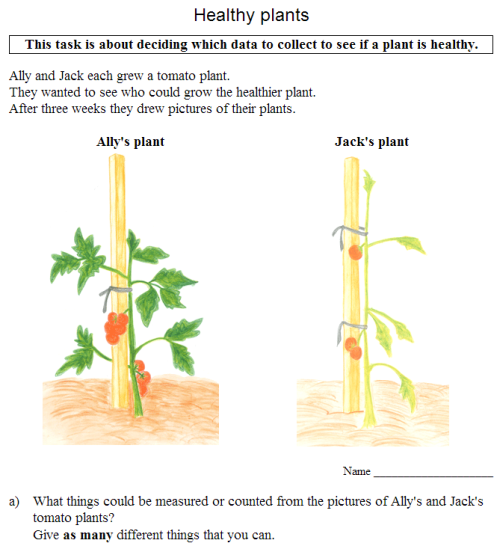
For this particular class a science topic on growing and caring for plants was chosen to support students’ understanding of life processes. The statistical enquiry would work well with the science investigation. Healthy Plants (ST8108) Level 2 and Healthy Tomato Plants (ST8105) Level 3 could be a useful way for students to think about the many different types of data, and what data is important to notice. This activity focuses on the planning stage of the enquiry. The teacher guide explores a range of answers the students may give. A teacher could decide to start the unit with this task as it would provide the initial deep formative information about what a student is doing and thinking or it could be introduced at some other point in the teaching and learning sequence.
From the teacher notes: