Nail investigation

Nail investigation

Pencil and paperOnline interactive
Overview
Using this Resource
Connecting to the Curriculum
Marking Student Responses
Further Resources
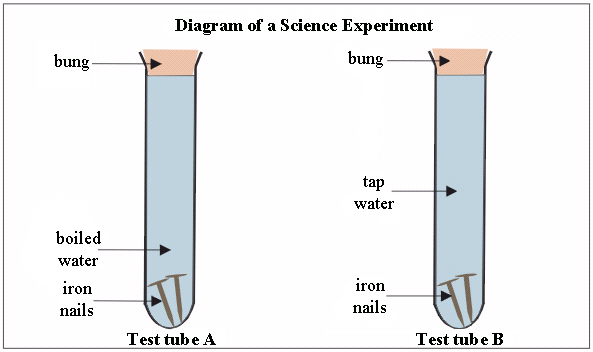
This task is about investigating how an iron nail rusts.
diagram of a science experiment with iron nails in test tubes
Information: The boiling of water removes dissolved gases.

Question 1Change answer

a)  What is the aim of this experiment?

Question 1Change answer

b)  In this experiment, what are three variables that need to be kept the same?
1. 
2. 
3. 

Question 1Change answer

c)  Why were two nails used in each test tube?

Question 1Change answer

d) i)  At the end of the investigation, the nails in which test tube would have shown the greatest change?
Test tube: AB

Question 2Change answer

ii)  Describe what the nails in this test tube would look like.

Question 1Change answer

Information: Calcium chloride is a drying agent, this removes moisture from the air.
 
e)  A second experiment was set up as shown above. What do you think is the aim of this experiment?
Task administration: 
This task can be completed with pencil and paper or online (with SOME auto marking).
Level:
5
Key Competencies: 
Description of task: 
Students look at two diagrams. The first shows iron nails in test tubes with boiled water or tap water, the second shows iron nails with moisture either present or absent. Students answer five questions about these investigations.
Curriculum Links: 
Science capabilities
The capabilities focus is brought about by the conversations you have and the questions you ask.
Capability: Gather and interpret data
This resource provides opportunities to discuss the importance of controlling variables when using fair testing for an investigation.


Science capabilities: 
Answers/responses: 
 

Y10 (10/2001)

a)   To determine if air is needed for iron to rust. very difficult
b)   Any 3 of: 

  • Temperature.
  • Length of time.
  • Size of nail.
  • Size of test tube/same amount of water.
  • A bung in each test tube.
3 correct - difficult
 
2 correct - easy
 
1 correct - very easy
c)   Any 1 of: 

  • Same as conducting a repeat experiment.
  • To make it a fair test.
moderate
d) i)
ii)
B
Red brown or orange in colour, flakey bits
[Do not accept rust/corrosion as these are inferences and are not descriptions].
difficult
e)   To find out if water is needed for iron to rust. very difficult