
Building percentages II

Building percentages II

Pencil and paper
Overview
Using this Resource
Connecting to the Curriculum
Marking Student Responses
Working with Students
Further Resources
This task is about finding percentages of given heights of buildings.

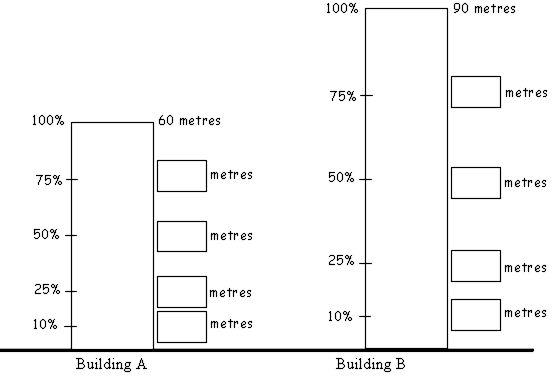
Below are sketches of two buildings. Each building’s height is given in metres.

a)
Find the height (in metres) at the marked percentages for Building A. 
Write your answer in the boxes opposite the percentage.
   
b)
Find the height (in metres) at the marked percentages for Building B. 
Write your answer in the boxes opposite the percentage.
 
c)
Explain how you used the diagrams above to find 75% of the height of Building A.


d)
Explain how you could use the diagrams above to find 35% of the height of Building B.


Task administration: 
This task is completed with pencil and paper only.
Level:
4
Description of task: 
Students convert heights of a building into the percentage of the given total height, explaining how they solved some conversions. Assessment focus is on how they calculate these heights and what strategies they use.
Curriculum Links: 
This resource can help to identify students' ability to apply additive or multiplicative strategies flexibly to obtain percentages of whole numbers.
Key competencies
This resource involves explaining how they worked out a percentage of an amount. This relates to the Key Competency: Using language, symbols and text.
 
Learning Progression Frameworks
This resource can provide evidence of learning associated with within the Mathematics Learning Progressions Frameworks.
Read more about the Learning Progressions Frameworks.
Answers/responses: 
  Y8 (06/2006)
a)

Heights of Building A:
45
30
15
6

difficult (for all 4 heights correct)

difficult (for 3 heights correct)

b)

Heights of Building B:
67.5 (or 67-68)
45
22.5 (or 22-23)
9

very difficult (for all 4 heights correct)

very difficult (for 3 heights correct)

c) For any 1 of the following explanations:

  • added the 50% and the 25% to get 75%;
  • 100% – 25%;
  • 7 lots of 10% and half of 10% (5%);
  • other correct explanation.
 

difficult

d) For any 1 of the following explanations:

  • added the 25% and the 10% to get 35%;
  • 3 lots of 10% and half of 10% (5%);
  • other correct explanation
 

very difficult

Based on a representative sample of 149 students.
Diagnostic and formative information: 
Correct strategies
Finding 25%, 50%, and 75%
Most students who answered questions a) and b) correctly used successive halving to find 50% and 25% then combined them to find 75%.  Some students also found the heights by finding the mid-point between the heights of interest, e.g., 50% is midway between 0 and 60 (30), and 25% is midway between 0 and 30 (15).  When explaining how to get 75% a very small number of students described partitioning the total height into four parts and either adding 3 of these or multiplying by 3.

Finding 10%
To correctly derive 10% students needed to cease using a halving strategy and recognise that 10% of 60 is 6.  They could find this by partitioning the total height into 10 parts, each part representing 10, or recognising that 10% was the same as a tenth, and that a tenth of 60 is 6. 

Finding 35%
Finding 35% combines the "halving" and the "tenthing" strategies.  Students can add 25% and 10% or 3 lots of 10% and 5% – either way students are stretched beyond just using a halving strategy.

 
  Common error Likely calculation Likely misconception
a) 50  40  30  20 Counting back in tens. Continuing a perceived pattern.
a) &
b)
75  50  25  10 Writing percentages as the height of the buildings. Not understanding that a percentage is a proportion rather than a number or amount.
a) 45  30  15  7.5 10% is calculated as half of 25%.  
a) 45  30  15  5 10% is 12.5% minus a bit. 10% is approximated.
Next steps: 

Students who tried to approximate 10% by halving 25% to 12.5% and then subtracting "a bit" to get 5 may need to justify how half of 25% is 10% and try to find a more accurate way of working out 10%.  This may involve them re-thinking what the best way is to break down the total to find this percentage.  To find 10% students need to partition the total into a different number of parts or recognise the 10% as a known part, i.e., that 10% (or 1/10) of 60 is 6.

Students who counted down in tens from the total height or who wrote the percentages as the actual heights may not understand that the percentages are a proportion of the height of the buildings.  They may have had no experience of relating percentages to actual values as in this diagram.  The double number line is a tool that can support students to solve percentage problems by scaffolding the partitioning and recombining of the parts.  Students will need to be aware what 100% and 50% represent and that whatever happens with the percentages affects the height in the same way. 
Students could first be asked what 50% of the height is (if the building is 60 metres high), then 25%, and 75%.  Most students at this level will be aware of successive halving as a strategy, but may need some support to identify the building up of 25% units to make 75%.  They may also need support to look for another way to get at the "tenthing" needed to find 10%.  Questions like "How many 10%'s are in 100%?" combined with "What goes into 60 ten times?" will assist this process.