

On the job

Answer the four questions below and show how you worked it out. Do not use a calculator to answer the questions.
a) Hohepa worked in a store for 16 hours a week for 7 weeks over Christmas. Show how to work out how many hours he worked over that time.
|
__________ hours |
b) Paddy worked 14 hours per day as a security guard. He worked for 23 days. Show how to work out how many hours he worked over that time.
|
__________ hours |
c) James and Maraea dug 32 post holes per day on their farm. They worked for 27 days. Show how to work out how many post holes they dug.
|
__________ post holes |
d) 38 people worked for 195 days in the year. Show how to work out how many days they worked altogether during the year.
|
__________ days |
- Using repeat addition or skip counting where both numbers are multi-digit.
- Using doubling and halving additively or other mixes of multiplicative and additive strategies where both numbers are multi-digit.
- Using doubling and halving multiplicatively where both numbers are multi-digit or Using the place value partitioning but cannot consistently obtain a correct answer
- Using full place value partitioning or partitioning just one factor or rounding and compensation or doubling and halving multiplicatively where both numbers are multi-digit.
| Y8 (10/2010) | ||
| a) |
112 Working that involved any of the following:
|
easy easy |
| b) |
322 Working that involved any of the following:
(10 × 20) + (10 × 3) + (4 × 20) + (4 × 3) = 200 + 30 + 80 + 12 = 322
|
moderate moderate |
| c) |
864 Working that involved any of the above methods. |
difficult moderate |
| d) |
7410 Working that involved any of the above methods. |
difficult moderate |
Based on a representative sample of 183 Y8 students.
NOTE: Working can be considered as correct if any of the above strategies are used but an incorrect answer is given. This is why getting a correct method is easier than getting a correct answer.
This resource is about multiplying one-, two-, and three-digit numbers together and showing the strategy used. It assesses what strategies students use in multiplication situations. The problems allow a range of possible strategies to be used.
| Common response | Likely misconception | |
| a) |
742 (7 × 100) + (7 × 6) or 784 |
Place value misconception Treats the product 7 × 10 as 7 × 100 |
|
b) c) d) |
212 (20 × 10) + (3 × 4) 614 (20 × 30) + (7 × 2) 5740 (19 × 300) + (5 × 8) |
Misses the cross-over terms in the multiplication This is generally associated with "full" place value partitioning rather than the vertical algorithm. |
|
a) b) c) d) |
102 or 122 312 or 332 764, 854 or 874 6410, 7310, 7400 or 7510 |
Miscalculates by 10, 100 or 1000 This may be caused by not carrying correctly in either the vertical algorithm or in place value partitioning. |
See Student work samples [PDF] for a range of strategies that students' used.
- Students who used full place value partitioning or place value partitioning of just one number in part b), c) and d) had the two highest mean abilities. However place value partitioning of just one number had a higher success rate (72% vs 62%).
- Place value partitioning in a) had the highest success rate as this part was easier than the other parts. However, the mean ability of the students doing it was somewhat lower.
- Rounding and compensation was used by students with the third highest mean ability, but only about half (53%) of these students used it to obtain the correct answer. It was most commonly used in parts a) and d). In part d) the students were of high mean ability.
- Doubling and halving was used by students with the fourth highest mean ability, and had a high success rate (76%).
- The use of repeated addition, either by itself, or in conjunction with place value partitioning [e.g., 16 × 7 = (10 × 7) + 7 + 7 + 7 + 7 + 7 + 7] was used by students with low mean ability, and had a low success rate (25%).
- Students who stated the answer often gave the correct answer for part a) (68%), but fewer than a quarter gave the correct answer for parts b) – d). These students had a mid-range mean ability.
- Students who ignored all or some of the cross products also had a mid-range mean ability, but invariably gave an incorrect answer.
- Students who confused addition and multiplication had a very low mean ability, lower even than students who did not answer the question.
- A small group made a variety of multiplication errors and so gave incorrect answers. These students had a reasonably high mean ability.
Place value misconception
These students could be asked to estimate the answer, for example is it close to 5 × 20 or is it smaller than 7 × 20? They may then attempt the question again.
Misses the cross-over terms in the multiplication
These students need to relate different representations of multiplication, particularly the area model (see Numeracy Professional Development Book 6, Teaching Multiplication and Division, p 69), the "usual" and the "extended" vertical algorithm, and the full place value partitioning model.
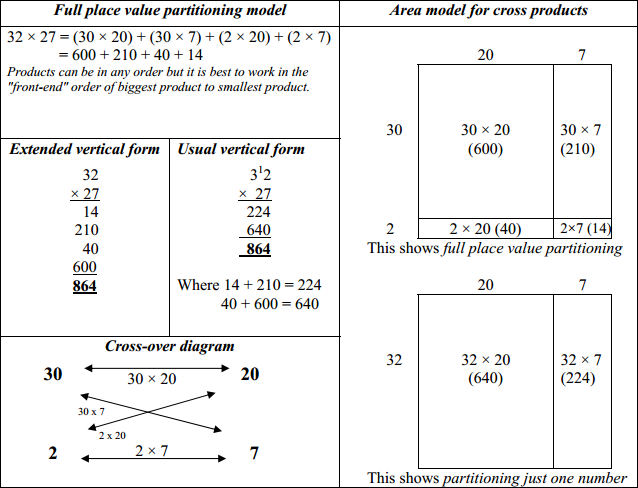
Miscalculates by 10, 100 or 1000
If the student is using the usual vertical algorithm and does not carry, get them to use the extended vertical form. If the student makes this error when using place value partitioning, they should lay out the numbers they are adding vertically, and recheck their calculations.
Numeracy Professional Development Book 6, Teaching Multiplication and Division, p 69
- Buying fruit and vegetables
- Which bottle size?
- Buying retro CDs and DVDs
- Sauces, jams and preserves
- Lengths of the pool
- Working out the weight
- TV game show
- Estimating sweets II
- Building a fence
- Estimating lots
- Indoor cricket scores
- Estimating sweets and buses
- Computer printing
- Estimate these
- Making necklaces
- Selling cars
- Multiplying and dividing decimals
- Money computations
- Multiplying and dividing fractions
- Using brackets II
- Younger brother scribble
- Estimating food numbers
- Who is estimating? Multiplication
- Estimating sweets
- Estimating in sport
- Estimating bags and boxes
- Ula lole
- Powerful twenty five
- Estimating multiplication
- Te Ahurei Kapa Haka
- Comparing prices
- How I estimate: Multiplication
- Bigger or smaller?
- Multiplying and dividing fractions II