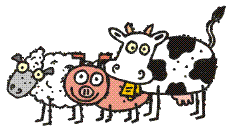

Farm animals

Farm animals

Pencil and paper
Overview
Using this Resource
Connecting to the Curriculum
Marking Student Responses
Working with Students
Further Resources
This task is about finding the simplest form of fractions from given amounts.
There are 360 farm animals on a farm: 
180 are sheep, 120 are pigs, and 60 are cows.
a) Show how to work out what fraction of the animals are sheep.


Write your answer in its simplest form: _____

b) Show how to work out what fraction of the animals are pigs.


Write your answer in its simplest form: _____

c) Show how to work out what fraction of the animals are cows.


Write your answer in its simplest form: _____

d) Show how to work out what fraction of the animals are either pigs or sheep.


Write your answer in its simplest form: _____

e) Show how to work out what fraction of the animals are either sheep or cows.


Write your answer in its simplest form: _____

Task administration: 
This task is completed with pencil and paper only.
 
Level:
4
Description of task: 
Students find fractions of numbers of different farm animals and put them in their simplest form.
Curriculum Links: 
This resource can help to identify students' ability to apply multiplicative strategies to partition quantities into common fraction parts.
Key competencies
This resource involves recording the strategies students use to find fractions of quantities. This relates to the Key Competency: Using language, symbols and text.
 
Learning Progression Frameworks
This resource can provide evidence of learning associated with within the Mathematics Learning Progressions Frameworks.
Read more about the Learning Progressions Frameworks.
Answers/responses: 
    Y8 (06/2006)
a) 1/2 (simplified from 180/360)
Working involving showing how to construct the fraction 180/360 and simplifying it to 1/2
moderate
difficult
b) 1/3 (simplified from 120/360)
Working involving showing how to construct the fraction 120/360 and simplifying it to 1/3
difficult
difficult
c) 1/6 (simplified from 60/360 or calculated from b) )
Working involving:

  • showing how to construct the fraction 60/360 and simplifying it to 1/6 ; or
  • recognising that there are half as many cows as pigs and finding half of b).
difficult
difficult
d) 5/6 (simplified from 300/360 or calculated by adding a) and b) )
Working involving:

  • showing how to construct the fraction 300/360 and simplifying it to 5/6 ; or
  • recognising that the number of pigs and sheep combined can be found adding a) and b).
very difficult
very difficult
e) 2/3 (simplified from 240/360 or calculated by adding a) and c) )
Working involving:

  • showing how to construct the fraction 240/360 and simplifying it to 2/3 ; or
  • recognising that the number of sheep and cows combined can be found adding a) and c).
very difficult
very difficult

Based on a representative sample of 168 students.

NOTE: The fraction should be given in its simplest form and working should show how students did this.

Teaching and learning: 

This resource is about simplifying fractions and showing appropriate working for constructing and simplifying the fraction.

Diagnostic and formative information: 

Simplest form
A significant number of students could construct fractions from the questions and show their working, but not find the simplest form of the fraction.  The most common of these fractions had a denominator of 360, indicating no simplification.  Some students simplified by halving (denominator of 180 or 90) and others removed the zeroes (either understanding the division by 10 or simply through some learned procedure).
Students who had partially simplified the fractions did better overall than students who gave unsimplified fractions as answers.

Insufficient working/no working
The most notable common error for all questions was simply writing the fraction or drawing a picture of the fraction instead of showing working.  Although accurate drawings can be used to show comparisons between fractions as well as simple equivalent fraction relationships, no appropriate drawings were used by students to show how to construct and simplify the fraction.  The amounts being worked with made diagrams unwieldy and difficult to interpret.

Fraction as rational number
A small number of students wrote the answer as a whole number, e.g., for question a) 180, b) 120 etc.  This would indicate a lack of understanding of what a fraction is, or how to construct a fraction.

Next steps: 

Students who could not write the fractions in their simplest form may need to explore different learning experiences with equivalent fractions of regions and sets and smaller numbers.  Students could explore creating more complex fraction names for simple fractions and explaining how they make them more complex.  They could look at equivalent fractions using sets or regions Drawing equivalent fractions.

For students who show insufficient or no working, ask them to explain how they solved the problem and write their steps down as they say them.  Then discuss the steps and how they show a process which is a very important part of the solution.

Students who could not write their responses as fractions may need a range of learning experiences with reading and writing fractions, and finding fractions of sets, regions and amounts.  These experiences should illustrate to students the convention of how fractions are written.  Students could then answer questions about identifying a fraction of a region, set or amount.

Links to the Number Framework
Working with equivalent fractions of amounts involves working with multiple factors for which students may need to be at the Advanced Multiplicative stage of The Number Framework – strategies.

Click on the link for further information about fractions as operators.

Numeracy:
Deci-mats explores equivalent fractions, and further identifies the decimal name for them.  (Book 7: Teaching fractions, Decimals, and Percentages, p.25). Fractional blocks and Trains are about finding fractions.  (Book 7: Teaching fractions, Decimals, and Percentages, pp. 15 & 19). Equivalent fractions (Book 8: Teaching Number Sense and Algebraic Thinking, p.16) is about converting any fraction to its equivalent fractions.